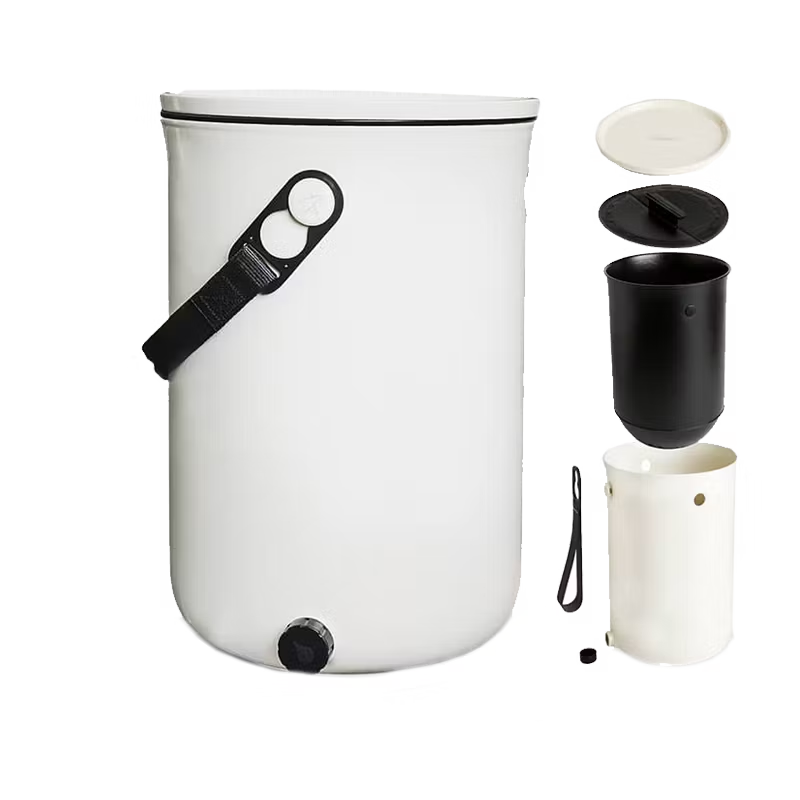
A Bokashi bucket should be as simple as possible. There are some requirements though. It should of course be dense as Bokashi is an airless fermentation, also called anaerobic. This is a sensible new variant with outer and inner bucket. Trigen the densest. Sold occasionally, which is possible if you use a plastic bag with drainage to mature. But it is advisable to buy two.
The dimensions of the bucket are:
Volume: 9.6 liters
Height: 34 cm
Diameter: 23 cm
Weight: 2.8 kg
Recycled material. Vanilla yellow. Probably safest to exclude air. Do not have a tap but only that you screw out a drainage hole. The whole bucket must therefore stand on something when emptying. Has an inner bucket, under which the leachate collects. Effective in creating leachate.
The strong leachate that is formed and can be emptied with the tap can be diluted 100 times and used as a good fertilizer. Really great to load Biokol with.
The advantage of this technology is that you can compost leftover food without a bad smell. Also partly animal food leftovers and cooked leftover food (which, however, should not dominate). This contributed to a popular movement with Bokashi. You also unwind bokashi litter. This is sold separately.
It is recommended not to open the bucket often as adding air is not good. It is a fast technique until the liquid stops forming. But it still takes a couple of weeks before it's time to put out the bucket's contents. During filling, the bucket should be as full as possible so that only a little air is above the compost. Should then be stored at normal indoor temperature. A bucket with ongoing fermentation where bokashi litter has been used and stored warm, while waiting that you rarely open, and a bucket with new material in a regular bucket with a lid. In that bucket you put down kitchen paper to soak up liquid. Above the bokashi litter. It must not start to rot. Then after a few days down in the real bokashi bucket. Try to avoid opening it often.
When you want to get the contents out of the garden, it is best to dig into the garden a couple of dm down or store in e.g. a sturdy plastic bag, even cold, for later use. I mean, at the same time mixing down Biochar, which becomes a buffer. Biochar has a pH of about 10, while bokashin has about a pH of 4, which is too acidic. If you do not use Biochar, there is a risk of acidifying the soil, which is bad for cultivation. However, does not apply where the soil is very rich in lime. This is to utilize the nitrogen in the substrate and reduce CO2 leakage. One should therefore let the plants' roots seek their way down to the Bokashifermentated. Does not work if the pH is still ? 4. At this time you still recognize what has been put down. It takes time before this becomes earthy. For that to happen, it is required that worms also want to come into being, I mean. It also requires higher pH. It is not good for a soil fertility with low pH. On ordinary moraine soils, sands, etc., the soil should have a pH of at least 6.0. In more clayey at least 6.5. Have grown on Gotland and saw no disadvantages with it. However, in other places with a low pH down to 5, I have seen major problems with getting good growth. There often with shallow topsoil. However, precipitation is now not as acidic as in the late 20th century.
Bokashi litter is sold separately.